There are places where night arrives. In Nocturne, it never left.
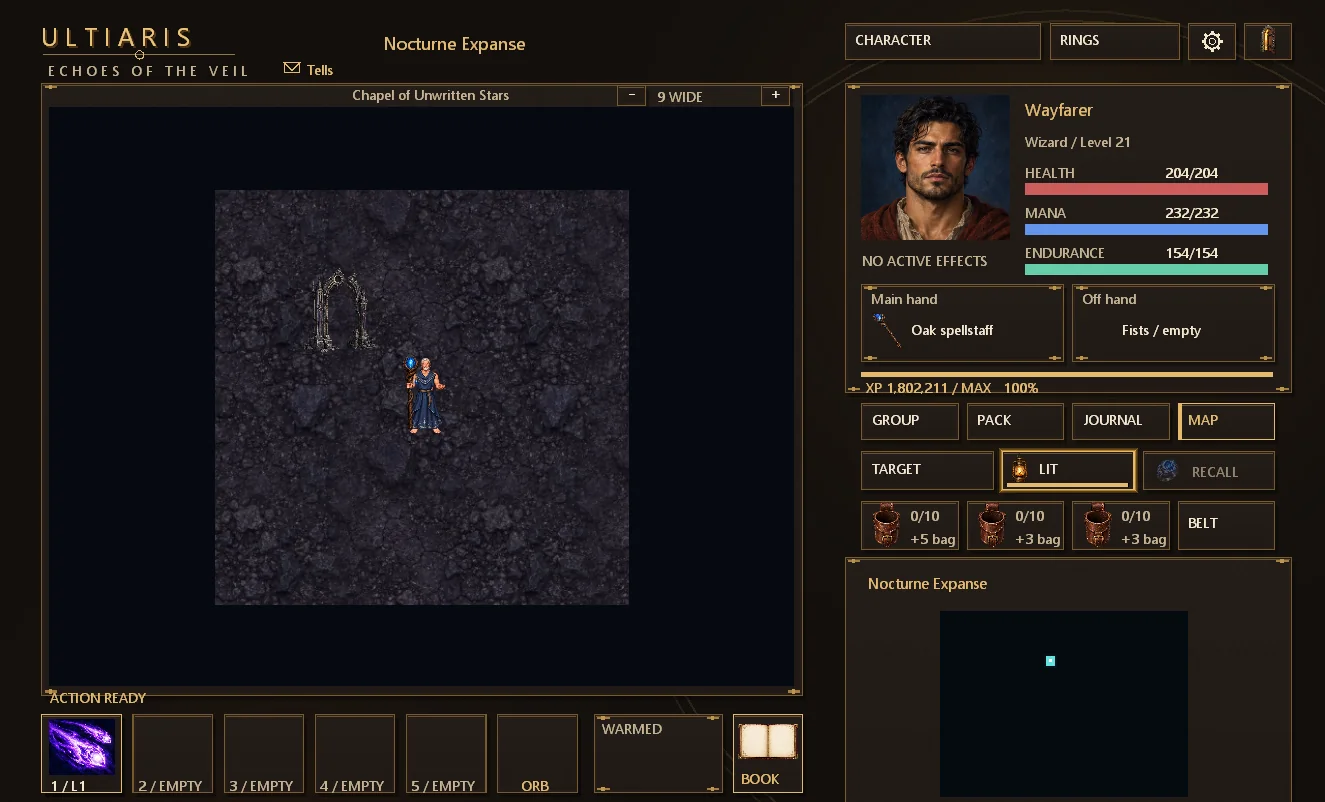
An artist’s impression of the Nocturne Expanse.
A lantern normally reveals the world. In Nocturne, it must first persuade the world to be revealed.
The darkness there is difficult to describe to someone who has only travelled after sunset. Ordinary night has a sky, a distant shape, the pale assurance that a road continues beyond the next tree. Nocturne withholds those things. Stone appears close to the flame and vanishes a few steps away. A companion's voice can become more reassuring than a visible horizon. The small circle around the lantern feels less like illumination than permission.
People who return tend to speak about sounds: footsteps coming back from the wrong direction, a chain drawn across stone, wind that seems to stop when listened to. They also speak about the extraordinary kindness of seeing another traveller's light.
A country before its curse
Nocturne was not born a realm of shadow. Its surviving roads were laid for traffic, not processions of the dead. Its chapels were places of gathering. Its court belonged to a kingdom that expected tomorrow to come and had elaborate plans for what should happen when it did.
That earlier country survives in fragments. An arch bears weathering from rain that fell in daylight. A worn step suggests generations of ordinary use. The proportions of an abandoned hall still anticipate a crowd. These details are more unsettling than an unfamiliar horror, because they make the place recognizable. People once lived here without needing to be brave every time they crossed a room.
What they called their country before the darkness is a matter for old records and careful listeners. Nocturne is the name that travelled outward afterward. Names given by frightened neighbours have a way of becoming more durable than the names people choose for themselves.
The king and the day after
The most persistent account concerns a king who feared the morning after his own death. That fear may have begun as a private sorrow. It may have disguised itself as concern for a kingdom, an heir or an unfinished work. The versions differ. What unites them is an impossible ambition: to hold back the sunrise and keep the world from entering a day in which he would no longer command it.
Avaroth's name remains attached to that ambition. In surviving accounts, the language of protection becomes the language of possession so gradually that few people recognize the change until it is complete. A country is to be preserved. A court is to remain together. A beloved hour is never to end. Each promise sounds gentler than the thing required to keep it.
Nocturne is the country left inside those promises. Its history is not simply a warning about darkness. It is a warning about what happens when a ruler mistakes the passing of time for disobedience.
The instruments that watched inward
Scholars in the warmer lands have long argued over unusual observations associated with Nocturne. Certain stars appeared in records where they did not belong. Dawn was measured as though it were an object with a weight and a direction. Astronomers who expected to study the heavens became concerned with something that seemed to be moving beneath their calculations.
The Ashen Observatory preserves part of that unease. Travellers remark on the strange attention of its instruments: the feeling that a place built to look outward has turned its gaze upon itself. Astronomer Cael speaks of the old work with the caution of someone who has found enough truth to distrust an easy explanation.
What the observers understood, and what they helped set in motion, belongs to the records themselves. The road to Nocturne is also a journey through the people who tried to understand it from a safer distance.
Black causeways and borrowed light
Within the Expanse, the remains of order are everywhere. Roads insist on their direction even when the land around them has become unrecognizable. Structures align with absences in the sky. A traveller can sense that the country once had a comprehensible pattern, then lose confidence in that pattern at the next turn.
The causeways are especially memorable. Their dark surfaces return little of a lantern's glow. A sound may carry along them far beyond the light that made it. They give the reassurance of something built by human hands and the dread of knowing those hands may have served purposes no longer understood.
There is beauty here, although it rarely offers comfort. An impossible constellation reflected where no sky is visible. Pale marks on stone that seem to gather rather than emit light. A stillness so complete that a single footstep becomes an event. Nocturne does not need to be loud to make its presence felt.
CAPTURED IN ULTIARISA lantern gives only a small circle of certainty in Nocturne. This is the light a traveller carries into the Expanse.
The refuge and its keeper
A refuge in such a country means more than a safe place on a map. It means that someone has chosen to remain, maintain a light and answer a stranger. Keeper Isolde carries that responsibility with the directness of someone for whom hope is a daily task rather than a speech.
Her warnings are practical. Bring light. Pay attention to the limits of what it shows. Remember that the next step exists even when it cannot be seen. Beneath those instructions is another insistence: Nocturne was not always this way, and the people caught in its history should not be reduced to the curse that surrounds them.
For visitors, the refuge becomes a measure of distance. Reaching it changes an expedition from a rumour into an experience. Returning to it changes a small doorway into something worth remembering.
What the night asks of each calling
Different adventurers find different questions in the Expanse. A Knight encounters the remains of oaths, and the uncomfortable distinction between keeping a promise and serving the purpose for which it was made. A Cleric finds places where mercy was interrupted rather than completed. A Wizard faces a sky that refuses familiar rules.
Those who study the Veil hear a different resonance in a land that has tried to halt an ending. Rogues know that a shadow can conceal a traveller, but may discover that some shadows are themselves held captive. A Martial Artist might recognize the discipline required to remain still in a place where stillness has become a threat.
These are not six answers to one riddle. They are six ways of meeting the same wounded country. The things brought home from Nocturne carry the memory of those encounters. A traveller may carry that memory far beyond the Expanse, into places where a different kind of courage is needed.
A palace beyond the stories
The Palace of the Last Eclipse is a name spoken with care. It evokes an ending held open, an hour unable to become either what came before or what should follow. Some accounts describe grandeur preserved past its purpose. Others describe a court in which the ceremonies continue because no one has been permitted to finish them.
What a traveller finds there should belong to the traveller. Stories can bring someone to the edge of a difficult country; beyond that point, they ought to leave room for discovery. Nocturne has enough witnesses who spoke on behalf of others. An adventurer should have the chance to form an account of their own.
The drowned orrery and the funeral road
The old astronomers raised their instruments above black pools, hoping to see a reflection of the sky their king had taken from them. Fractured rings and extinguished court stars still stand along the drowned orrery. The path bends between them, sometimes narrowing to a strip of stone above water that returns no face.
Farther on, the funeral causeway curls past fallen heralds. Their broken wings point toward a palace whose galleries were built for triumphal processions. Now the routes divide around ruined cloisters and meet again beneath cold arches. A familiar landmark can be a kindness; the same landmark glimpsed from an unexpected direction can make the country feel less certain.
Four descents into an unfinished night
The outer Expanse is only the first depth. Beneath its funeral road lies the Sunken Processional, where pilgrims once carried candles past bell terraces and black pools. Floodwater has taken the straight road. Travellers now follow the surviving bends of a ceremony whose destination was never meant to be questioned.
Below the drowned steps, the Hollow Crown keeps the names of heirs who never ruled. Broken cloisters surround empty seats, and memorial faces have been struck from the stone. A path may divide around a fallen pier and meet itself beneath another arch; the old builders understood procession, and the ruins have learned concealment.
The Palace of the Last Eclipse waits in the fourth and deepest reach. Each descent leaves the refuge farther behind and brings the king’s remaining servants closer. The outer roads are less fiercely held, but nowhere does the darkness become kind.
The Hollow Crown
Not all of Nocturne’s soldiers forgot their stations. Some still guard the approaches to the court with the patience of things that no longer measure years. Their armor carries the old kingdom’s pale ornament, and their ranks close around the road as though a royal procession were expected at any moment.
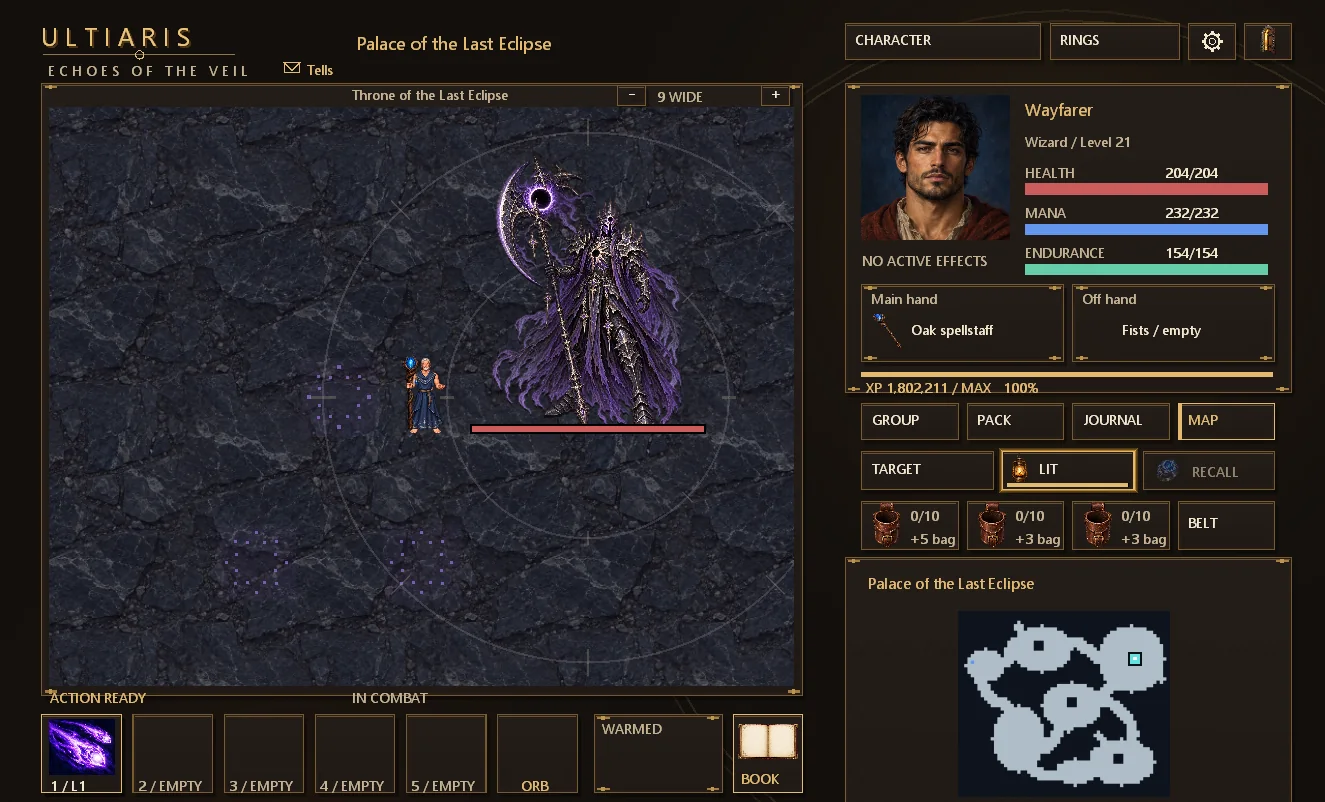
Beyond them waits Avaroth, King of the Last Eclipse. Travellers speak of a crescent blade and a crown around an absence, of stars that fall without crossing the sky. No song promises an easy victory there. Those who enter the final court would do well to remember the voices of the companions who came with them.
CAPTURED IN ULTIARISAvaroth’s court, shown with darkness lifted. On your journey, ordinary lantern light reaches just two squares into the night.
The dawn that belongs to everyone
In the towns beyond the Expanse, sunrise is an unnoticed gift. Shops open. A guard changes watch. Someone complains about being awakened too early. Nocturne makes that ordinary hour seem remarkable.
Perhaps that is why returning travellers often linger outdoors the following morning. They have seen a place where the day became something a powerful person believed he could own. The first light over Asterfall's roofs asks for no title, oath or payment. It reaches the inn, the treasury, the fountain and the road beyond the gates alike.
Whatever brings an adventurer into Nocturne—duty, curiosity, training, companionship or the search for an old story—the return can change the meaning of a simple thing. A lantern carried through darkness is one kind of courage. Believing that the darkness need not last forever is another.
Beyond the cold, an older fire.
Another distant land remembers a different attempt to hold something that would not be held.