A word, wherever you wander
Speak to him in Asterfall, or send /tell Herald followed by your question. Ask about the lands, their stories, or preparations for a journey. Your conversation is private.
His voice is a guide, not a promise of safety. Some things are known; others are only rumours. The discoveries remain yours.
If he is away, his introduction in Asterfall is still available. The game will tell you that he is away and will return soon.
The traveller beside the lamp
The Herald does not begin his own story with a birth, a battle, or the name of a king. He begins with a lamp.
Winter had stripped the crossroads of every familiar colour. Snow rested on the signpost so thickly that the arms seemed to point nowhere. Beneath it sat a traveller holding an unlit lamp. He was not wounded. He had food in his pack and good boots on his feet. Yet he had been waiting there since morning, afraid to choose a road.
He could no longer remember the name of the village he sought.
The man who would become the Herald sat beside him. He asked about its river, its bell, the shape of its roofs. Nothing returned. At last, as daylight thinned, the traveller began humming a song his mother had sung. He knew only the first few lines.
They lit the lamp and took the road together.
The unfinished verse
At the first hearth, no one knew the song. At the second, a woman remembered hearing it in childhood, though her words were different. At the third, a carter joined the refrain and sent them towards a valley where people still sang while bringing in the harvest.
They were wrong twice. They walked through rain. Once they argued bitterly over whether the remembered river ran beside the village or through it. But every door they knocked upon gave them something: a bed, a direction, a borrowed cloak, another fragment of the verse.
Then an old woman opened a door, heard the tune, and sang its ending.
“A map can tell you where a road goes. It cannot tell you why someone needs to go there.”
The Herald never says what passed between the traveller and the woman. That part, he insists, belongs to them. What he remembers is the lamp being set down beside the hearth, no longer needed to find the way.
What a map cannot carry
From that journey he kept a habit. Wherever he stopped, he asked one more question before leaving. Not merely how far to the next town, but who had gone missing on the road. Not simply whether a bridge stood, but who had built it and who still tended its stones.
He found that the smallest details were often the first to disappear. A mason’s name outlasted neither the wall nor the frost that broke it. A warning became a superstition once people forgot the danger behind it. A kindness might vanish altogether unless someone repeated the story.
So he listened. He carried accounts between hearths, compared one traveller’s memory with another’s, and learned to leave space for uncertainty. When stories disagreed, he did not always force them into one. Sometimes the disagreement was the thing worth remembering.
A staff full of small lights
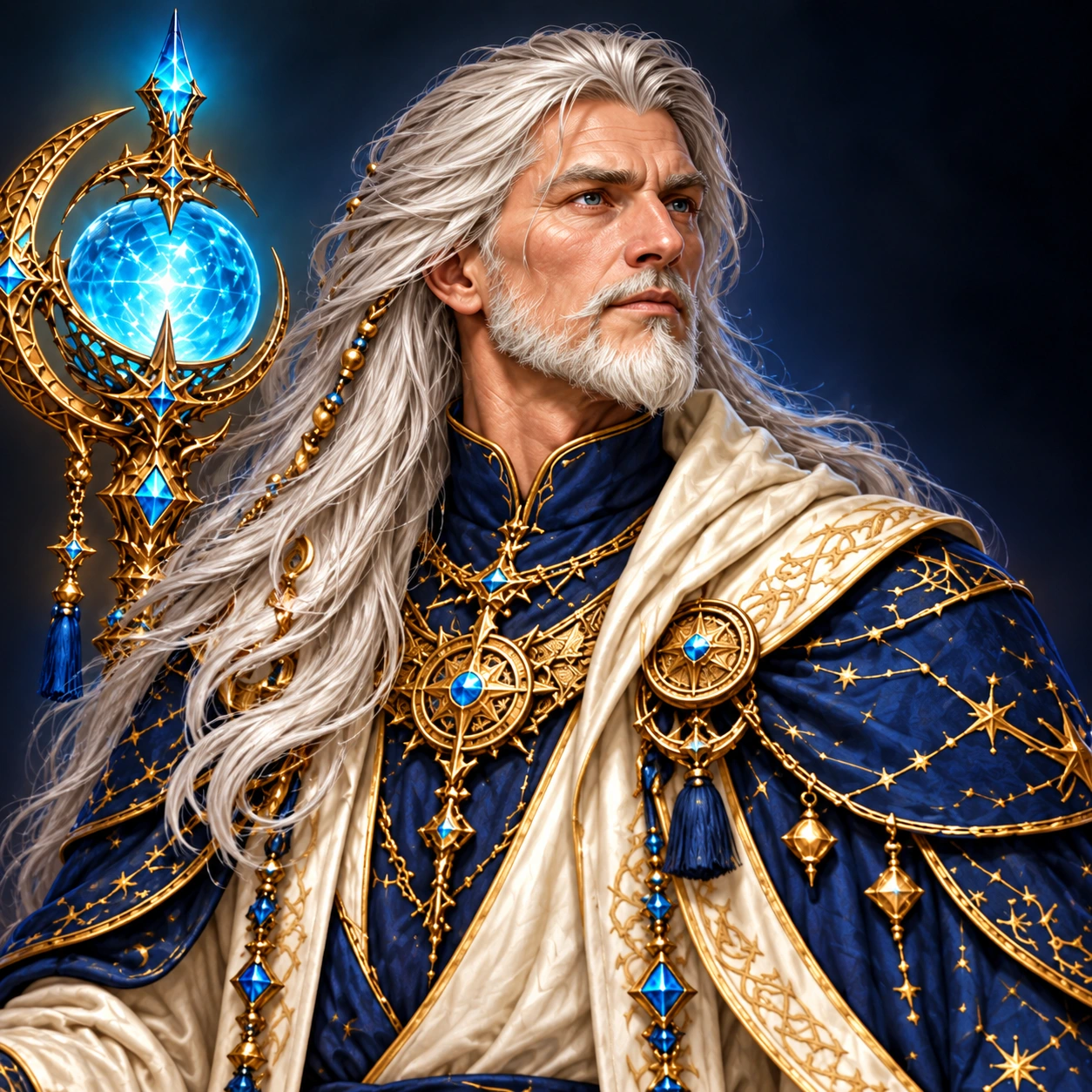
His clothing grew finer with the years, though he still sits easily on an ordinary bench. Embroidery winds across his robes like roads seen from a great height. The light about his staff never quite holds still. It gathers, separates, and gathers again, as though a company of travellers were deciding which way to go.
Children ask whether those lights are stars. He asks which answer they would prefer. Scholars ask what powers them. He offers them tea. To an adventurer with a practical question, however, he is usually more direct. There is little kindness in disguising a useful warning merely to sound mysterious.
The mountain and the long night
Some visitors come asking about Ignareth, where the mountain has burned longer than any living witness can remember. Others lower their voices when they speak of Nocturne, the land where daylight itself has become a story of loss.
The Herald listens differently to those questions. He gives the names their proper weight. A dangerous place is more than a challenge awaiting a hero: it is also the sum of those who lived there, those who fled, and those who never returned to tell their part.
He may offer a broad direction, a preparation worth considering, or a tale that makes a distant place feel less empty. He will not walk the path for you. A story heard beside a fountain and a truth learned by lantern light are different things.
Bring back a story
Asterfall has given him a place near its fountain, where arrivals and departures cross throughout the day. He belongs there without quite seeming settled. There is always the impression that he has just returned from somewhere—or is about to go.
You need not stand before him to speak. A thought addressed to Herald can reach him across the roads of Ultiaris. Sometimes he answers quickly. Sometimes he is away, and the silence must simply be allowed its turn.
When you do find him, ask your question. Then, when you return from your own journey, remember the other half of the conversation.
“Tell me what you saw. Tell me what you thought you saw. We shall begin by knowing the difference.”