Before the oldest road had a name, Ignareth was burning. The road has vanished. The fire remains.
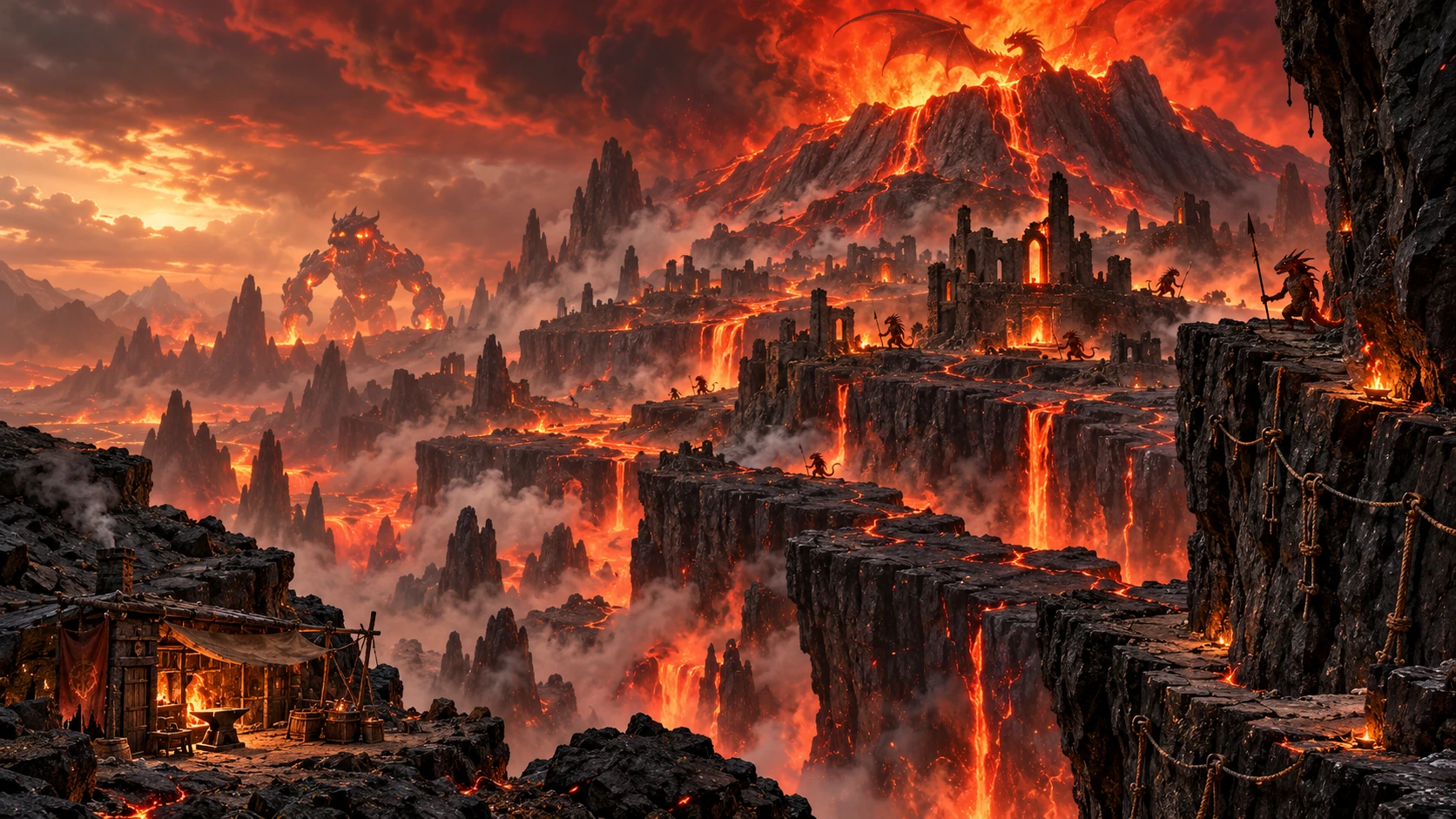
An artist’s impression of the Everburning Mountain.
The first thing travellers hear is usually a story. The first thing they remember is the sound.
In Asterfall, the story changes with the speaker. A merchant describes a distant red stain on the northern clouds. A bard puts a drum beneath a verse that seems older than its words. A man with an uneven eyebrow insists the mountain tried to eat him, then falls quiet when someone asks what he left behind. The accounts disagree about distances, dates and the size of the creatures. They agree about the fire. Ignareth has never stopped burning.
A road beyond the familiar roads
There is no convenient gate from Asterfall's square to the mountain. Reaching it means leaving the familiar roads behind, crossing frontier country and travelling beyond the face of winter most people know. Long before the volcano becomes visible, it begins to make itself felt. Frost loosens its grip on sheltered stones. Water runs beneath ice where the sun cannot reach. A cold passage exhales air that smells of iron.
Old travellers call this the mountain's first warning. It is also its first invitation. There is a particular temptation in warmth after a difficult journey through cold: the impulse to stop thinking about why it is warm. Ignareth has profited from that mistake for centuries.
The approach passes beneath stone. Above, snow can settle on a ridge that conceals a deep vein of heat; below, meltwater finds black rock polished by a much older river. Iron braces survive in the passage, their ends swallowed by mineral deposits. Whoever placed them expected people to use this road for a long time. They were right, although perhaps not in the way they intended.
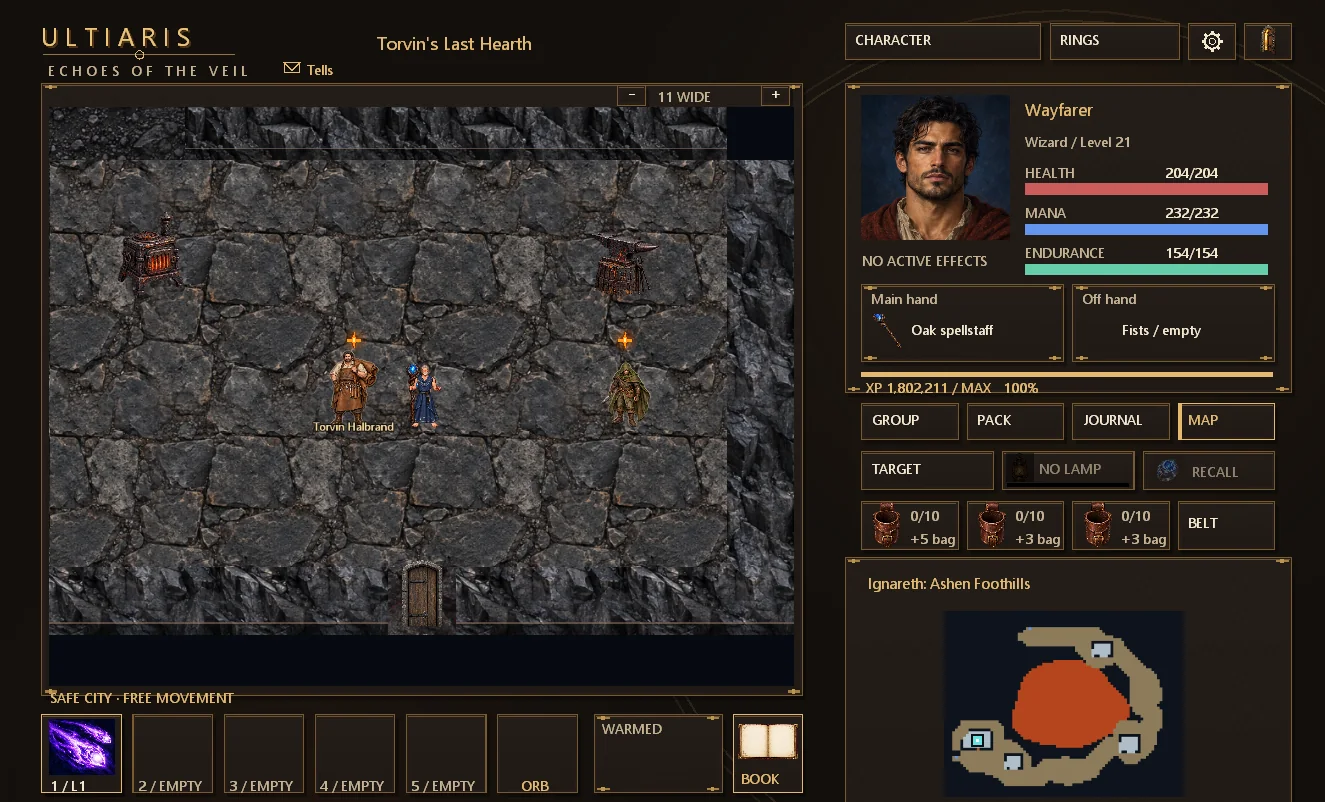
CAPTURED IN ULTIARISA small refuge beneath the Everburning Mountain. Beyond its hearth, the long climb begins.
Emberhollow, where winter could not enter
There was once a village on the lower mountain. Emberhollow was a practical name, given by practical people. Its residents built homes beside a source of heat that did not need chopping, hauling or sheltering from rain. They learned where to draw water, where to lay a foundation, and which cracks in the ground must never be covered. Terraces held their gardens. Channels carried meltwater across stone. Workshops faced the slopes so a smith could judge the mountain's temper before opening the doors.
It is easy to imagine the place only as a ruin. Look more closely and it becomes a home. A chimney stands where the rest of a house has fallen. A painted mark survives beside a doorway. The shape of an oven remains under ash. People ate here, argued over tools, waited for relatives and complained about the weather. Their ordinary lives are the measure of what was lost.
The village's craftsmanship travelled farther than its people. Caravans carried stories of iron that held its warmth through a northern night, of ropes that endured furnace heat, of smiths who listened to metal before striking it. Some accounts are surely embellished. Yet the mountain has consumed bridges, roofs and entire stretches of road, while certain old ropes still hang between its ledges.
The climb through a broken inheritance
Ignareth is not a single road to a summit. Its flanks fold into ledges, gullies and shelves. An easy-looking slope can end in a fresh break. A sheltered corner can open abruptly onto a view down several hundred feet of ruined terraces. Old routes wind around the cone because the people who made them understood that the direct way was often the shortest way to die.
Each ascent leaves a different part of Emberhollow behind. Lower houses give way to terraces and the remains of an aqueduct. Farther above, the mountain grows harsher and its industry more imposing. Broken galleries overlook channels that still glow. Stonework has slumped without entirely falling. In places, a wall appears to have softened around the thing it was meant to protect.
There are moments of shelter: a recess out of the wind, the lee of an old wall, a patch of firm ground beside an anchor. They matter because the mountain seldom grants stillness for long. A party learns to recognize a place where everyone can breathe, gather their thoughts and hear the next warning.
Life in the furnace
The things that inhabit Ignareth have inherited more than heat. Salamanders nest in houses that no longer keep people warm. Small shapes move through the ash beneath broken floors. Winged creatures use currents rising from fissures. Above them, heavier forms grind their way through places where flesh should not survive at all.
The distinction between creature and landscape is unreliable here. A boulder beside a path may have stood there since the village fell. It may also rise when approached. Glowing seams can mean a rock is cooling, a vent is waking, or something inside the stone has become aware of you. Experienced travellers do not describe the mountain as empty ground populated by monsters. They describe a place in which the ground itself has acquired habits.
Not every presence belongs to the fire. Among the remnants of homes and shrines, the temperature can fall unexpectedly. There are corners where the ash seems reluctant to settle, and voices that cannot be explained by wind. Emberhollow's ending left more behind than stone.
A guardian without a village
The old forge has its own place in the northern songs. In some versions, its keeper was a master smith wearing armor no flame could touch. In others, the smiths built their keeper from the workshop itself, setting duty into stone as a jeweller sets a gem. All the songs end with the same image: a guardian still walking after the workers have gone.
Kharzun is the name that survives. Those who have heard it spoken near the mountain say it should be given quietly. There is no agreement about whether the guardian remembers whom it protects. There is considerable agreement about the sound of its footsteps.
The breath above the eruptions
Higher still, the mountain opens. Its throat casts light onto the underside of smoke, and the wind carries grit hot enough to sting. Here the stories stop sounding comfortably distant. A shape on the crater's edge can be mistaken for part of the mountain until it moves.
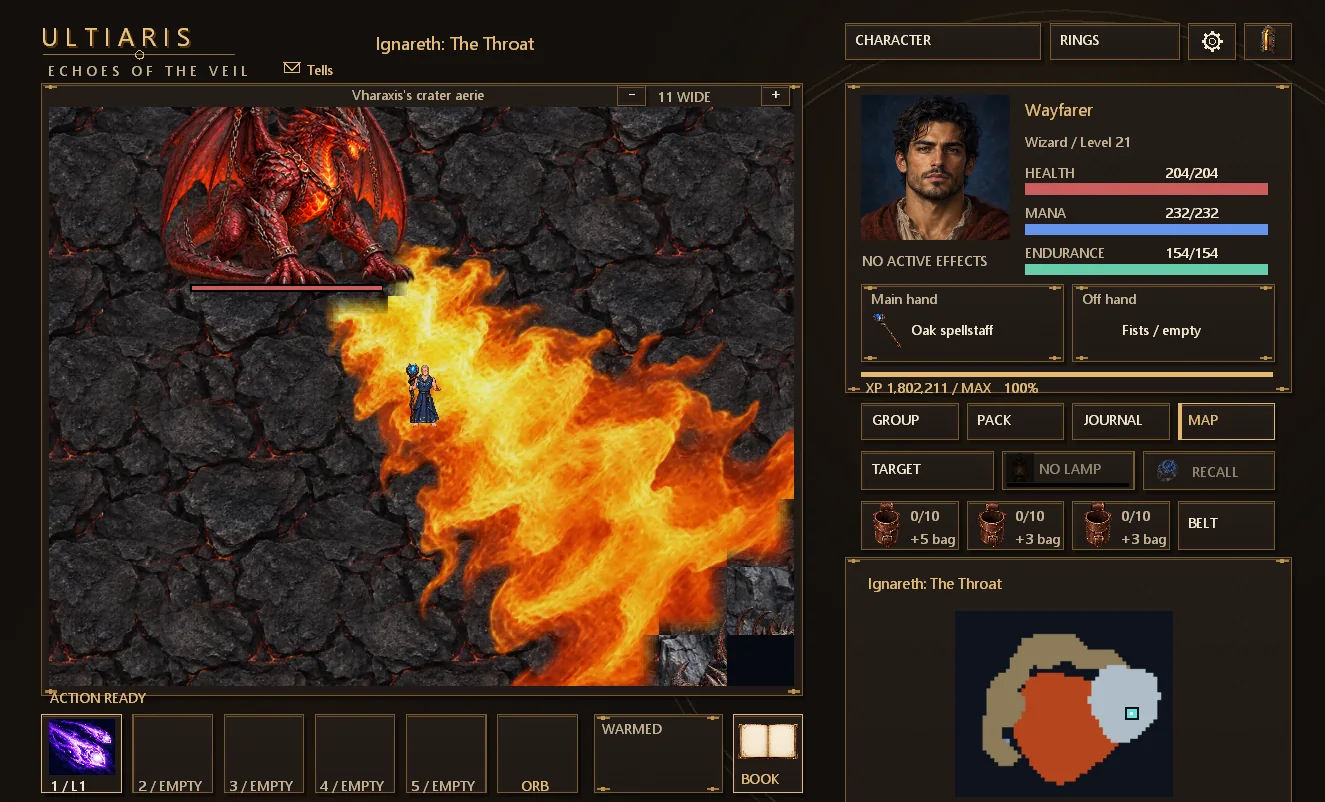
Vharaxis. The Everburning Wyrm. The name appears in songs that disagree about nearly everything else. Some call him the mountain's oldest inhabitant. Some say the first eruption was his first breath. The careful versions make fewer claims. They tell travellers to listen between the great rumbles, and to leave if the silence seems to inhale.
What lies behind the oldest accounts is a question for those who climb. The mountain has kept its own counsel for thousands of years. It will not surrender every truth to a tavern story.
CAPTURED IN ULTIARISVharaxis pours fire across the crater’s blackened stone. The oldest stories have not exaggerated everything.
The door at the foot of the mountain
A small outpost survives near the base. It is the sort of place that matters more than its size suggests: a stove, a shelf of supplies, a door that shuts firmly against blowing ash. Torvin Halbrand conducts business there with the weary precision of a man who has heard every ambitious promise an adventurer can make. He recommends counting supplies before discussing glory.
Nearby, a quieter profession has found a place. The ash paths sometimes return belongings their owners could not carry home. Such work attracts someone who knows how to move without advertising the journey. Questions about those methods tend to receive a price rather than an answer.
Back in Asterfall, The Copper Kettle keeps its hearth for less alarming purposes. Maela knows a song about the mountain. Dagny knows what it feels like to run down it. Neither offers the whole adventure. They offer something more useful at the beginning: a reason to leave, and a reminder that coming home matters.
The next story begins on the road.
Far from the mountain, another land waits beneath a sky that has forgotten morning.